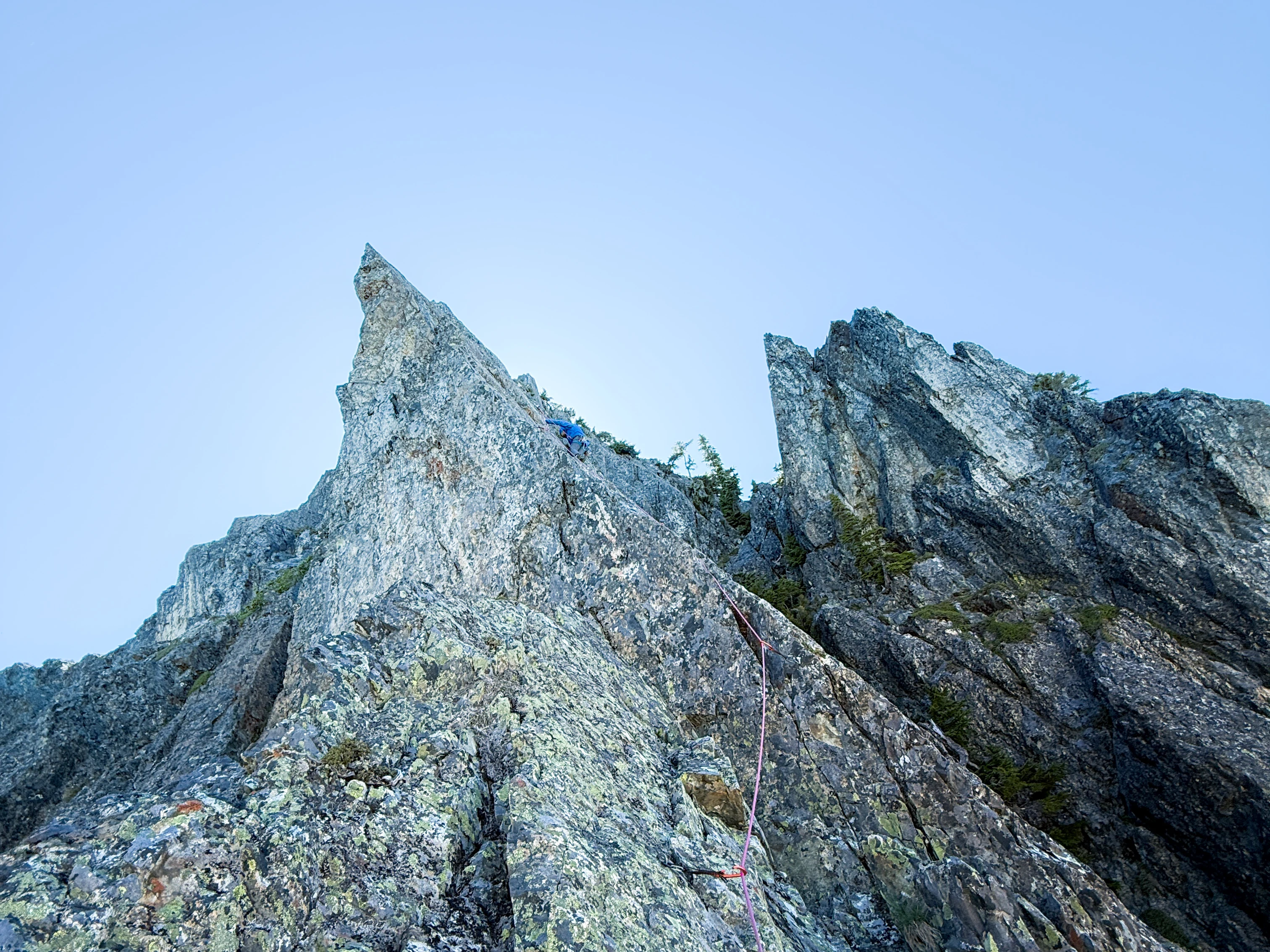
June 17, 2026 · Snoqualmie Pass, Washington
The Fang: Free Climbing the Edge of Time Arete
A rock climb up The Edge of Time Arete to the summit of The Fang, in the Alpine Lakes high country above Snoqualmie Pass.
- Distance
- 7.97 mi
- Elev. Gain
- 2,516 ft
- Time
- 11.73 hr
- Coords
- 47.4471° N, 121.4560° W
GPS track for route beta. Conditions change constantly, so verify your route and navigate at your own risk.
A long, exposed day on the rock above Snoqualmie Pass, and exactly the kind of challenging climb I had been missing. The Edge of Time Arete line on The Fang is a bolted route with pitch after pitch of fun, airy climbing. This was the most pitches I have ever linked on a single sport route, so stoke was insanely high.
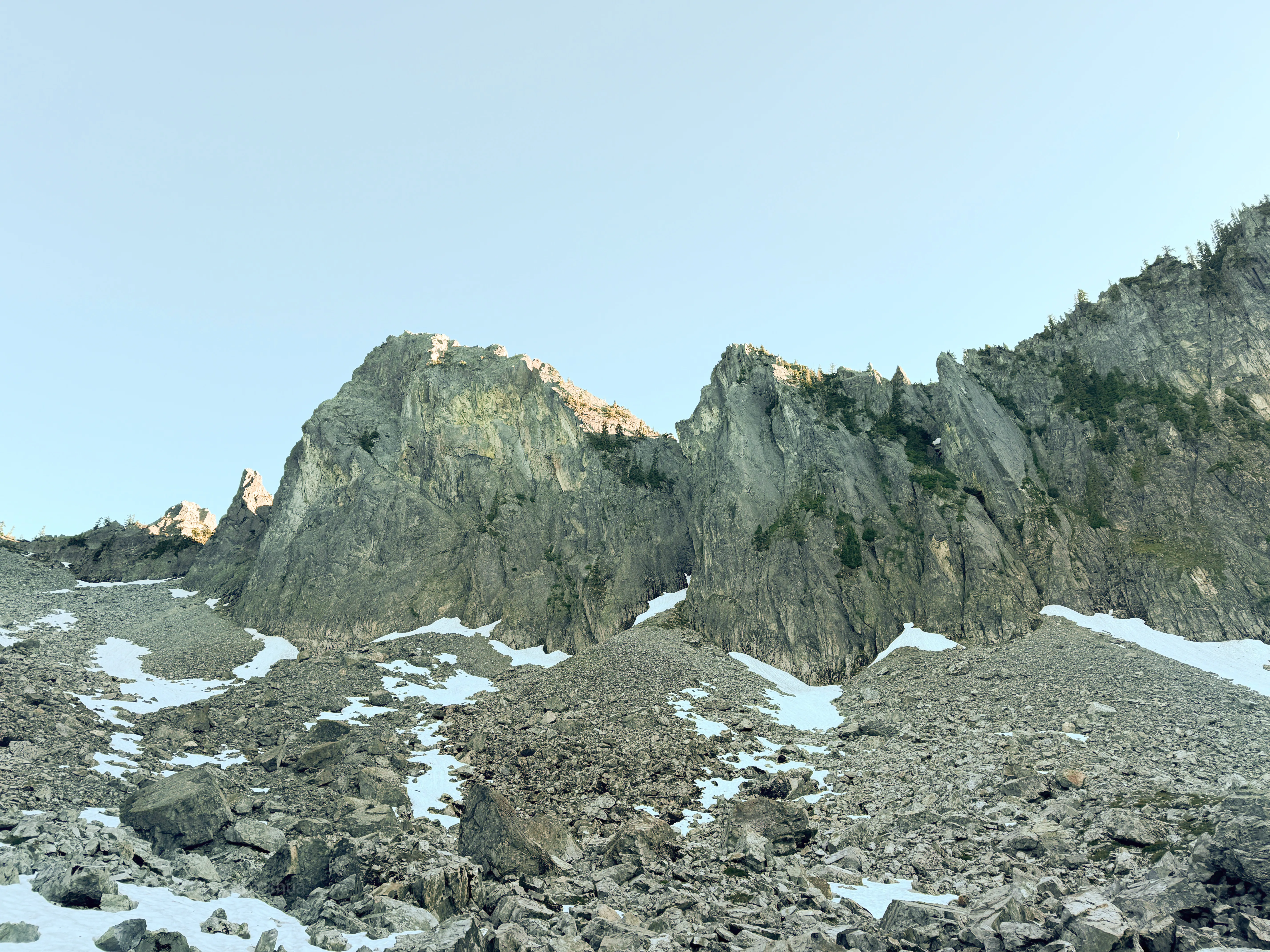
The Fang and The Tooth, with Pineapple Pass off to the left of the Tooth
Beta
- Route: The Edge of Time Arete, The Fang. Bolted multipitch, crux 5.10a.
- Rope: A single 60m was fine. On the rappel from the base of P5 you go to the knots, so tie stoppers and keep them near the ends.
- Gear: No snow gear. Dirt and rock all the way to P1.
- Time: Just under 12 hours car to car, starting around 0900. Plan for a long day given the pitch count. We were slow.
- Conditions: Trail in good shape and easy to navigate to The Fang and The Tooth. Getting buggy, so bring spray, especially for the parking lot.
- Safety: Avoid the X-marked holds on the 5.7 and 5.8 lead pitches. They look good but they are loose.
The Approach
We left the trailhead around 0900. The trail was in good shape and easy to follow all the way up toward The Fang and The Tooth, no route-finding headaches right now. It is dirt and rock the whole way to the base of P1, so leave the snow gear at home. No crampons, no ice axe, nothing like that needed.
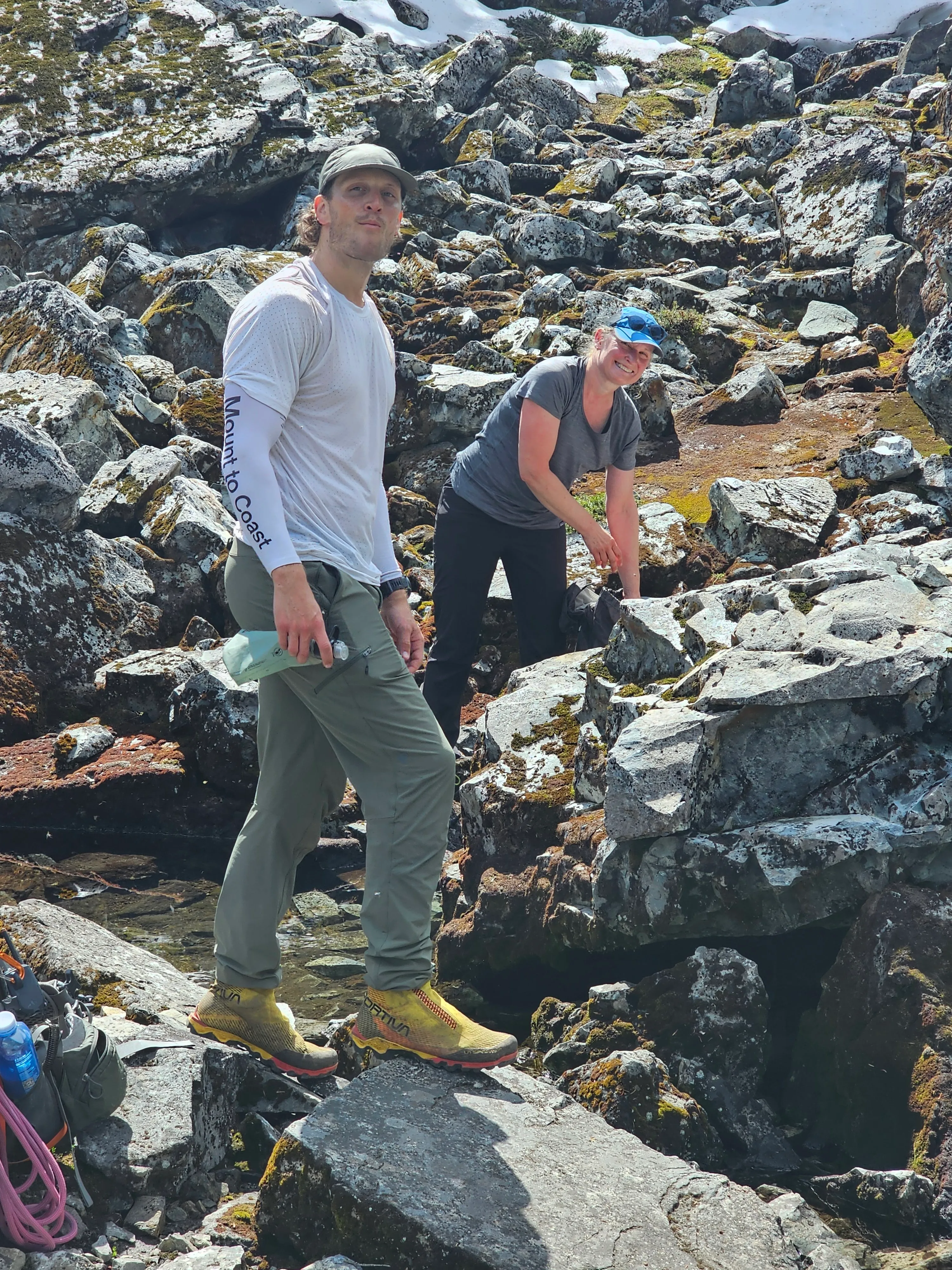
The mountaineering boots I hauled up and never needed. Photo by Bob
One heads-up: the bugs are starting to cook, especially in the parking lot. Bring spray. There were marmots, pikas, and birds all over the place too, which made the approach a good time. We only had one party of two ahead of us. Almost everyone else that day was over on The Tooth.
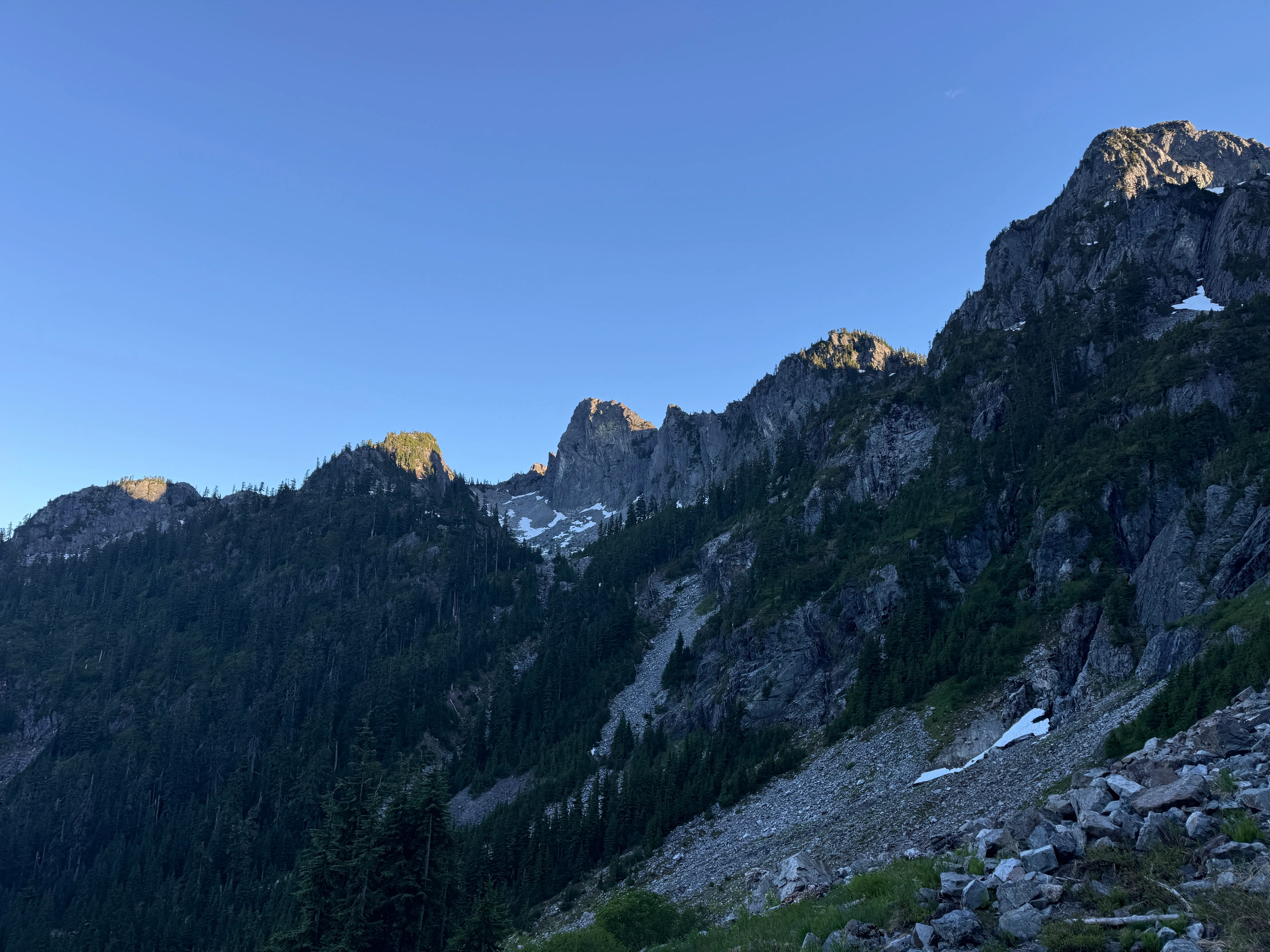
The Fang and The Tooth, June 2026 conditions
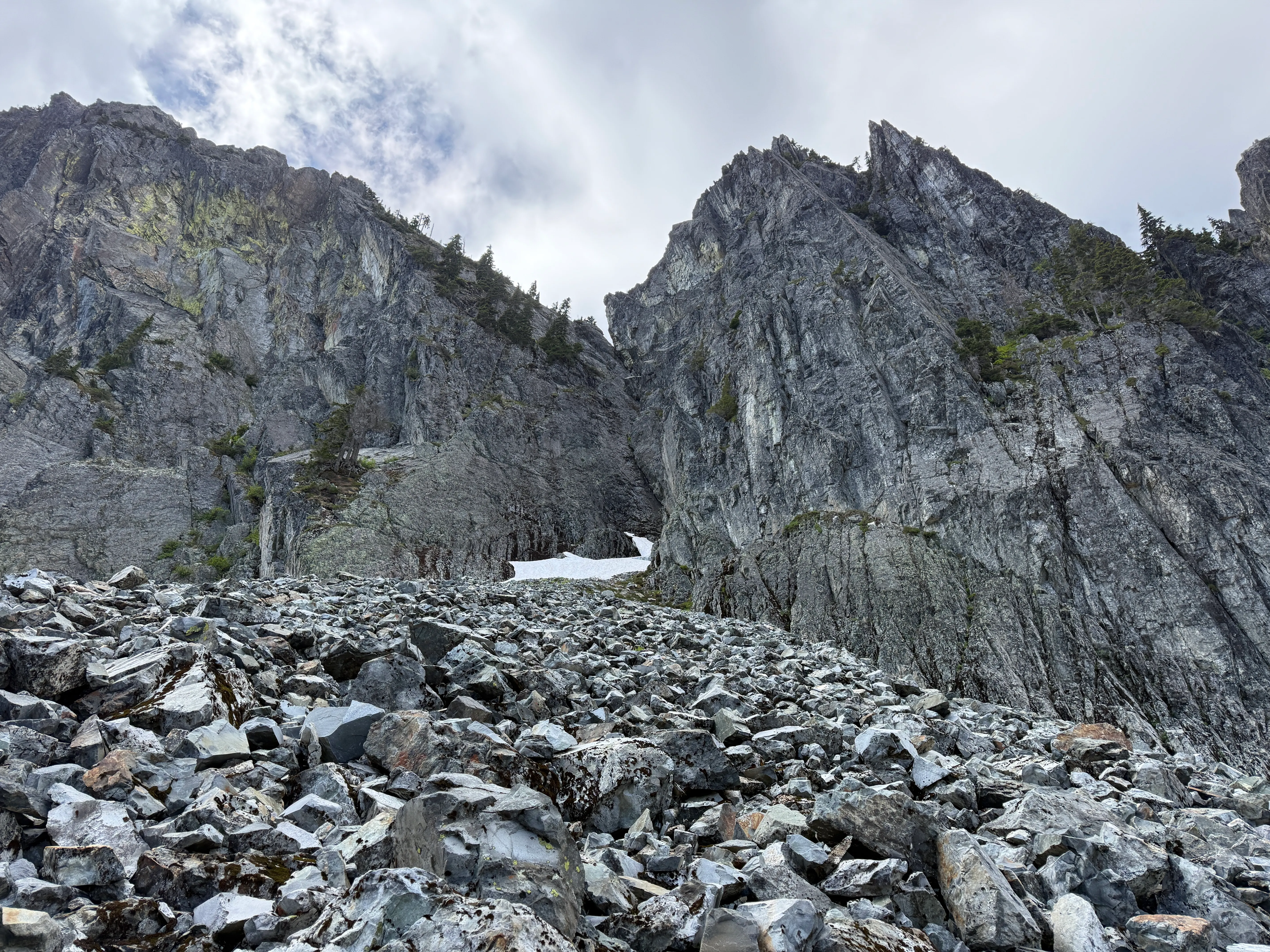
The final approach, fully melted out in June 2026
As we approached the base of the route, we found ourselves in the shade of The Fang, and the wind suddenly had a bit of a bite. Going from sweating in the midday heat to getting blasted by cool wind was quite the transition. I think we were all happy to have our windbreakers and layers, which had seemed like a total waste to bring at first.
The Climb
We were a team of four, climbing as two rope teams. Mark and Christine led out first, with Bob and me right behind.
The climbing is exposed and a ton of fun. A 60m rope was plenty. Mark and Bob both sent the crux 5.10a pitch and made it look easy. I was happy to get a string of really exposed leads in and rebuild some confidence. It had been a long time since I got on a climb this challenging, and it reminded me how much I love it.
A route-finding note for the start: the first pitch belay station is just a nut wedged firmly into a crack. You will find it straight down from the big blocky white stone on the Rising Tide ledge above.
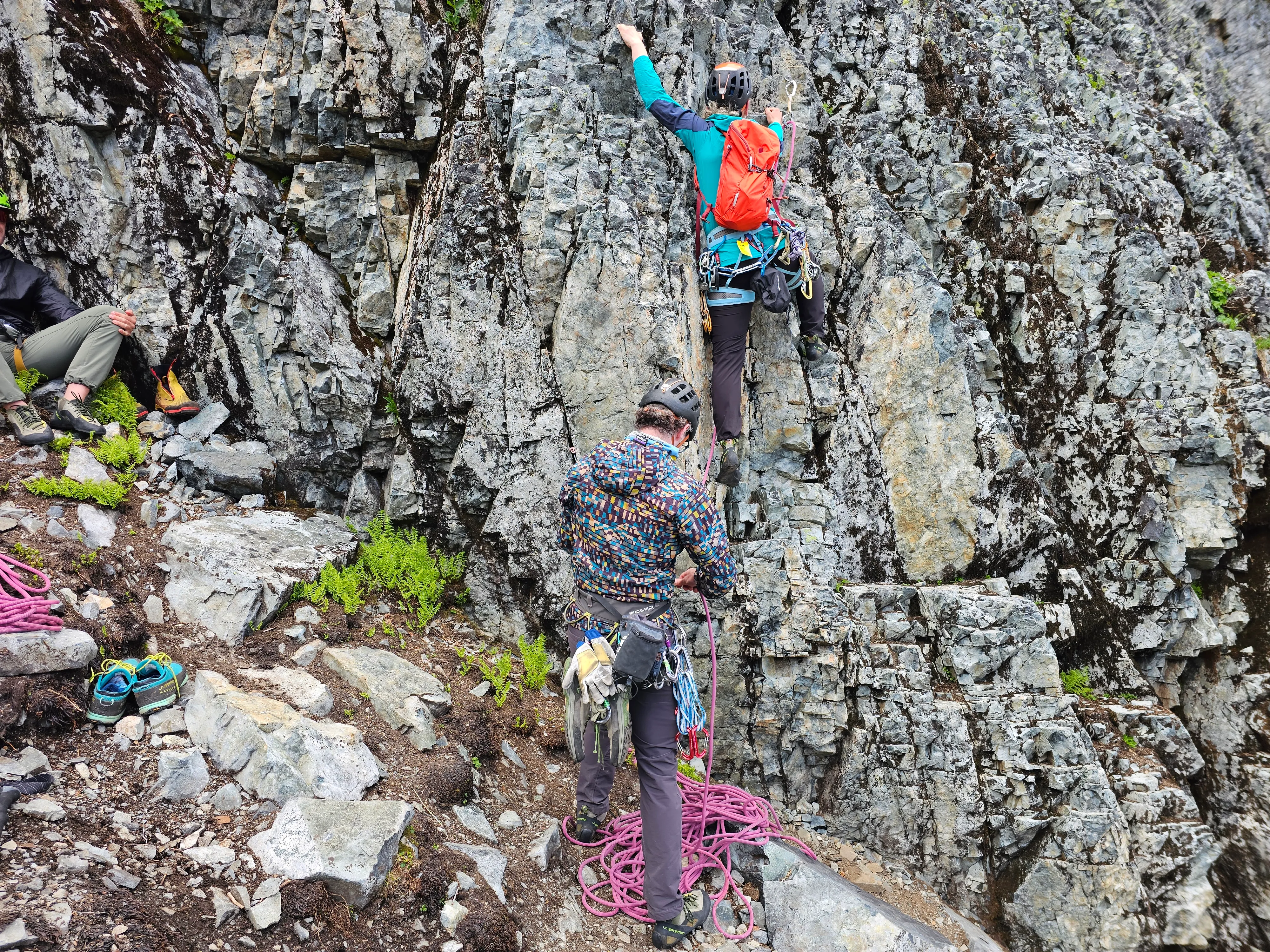
Mark and Christine starting up P1. Photo by Bob
Many people call this one of the best sport routes in Washington, and after climbing it I get why. The bolting and the belay stations are thought out extremely well. The stations sit off to the left to keep you out of the rockfall line, and the bolts run only about 10 to 12 feet apart, so you never feel like you are running anything out. I do not have many big multipitch sport routes to compare it to yet, but that should change by the end of summer.
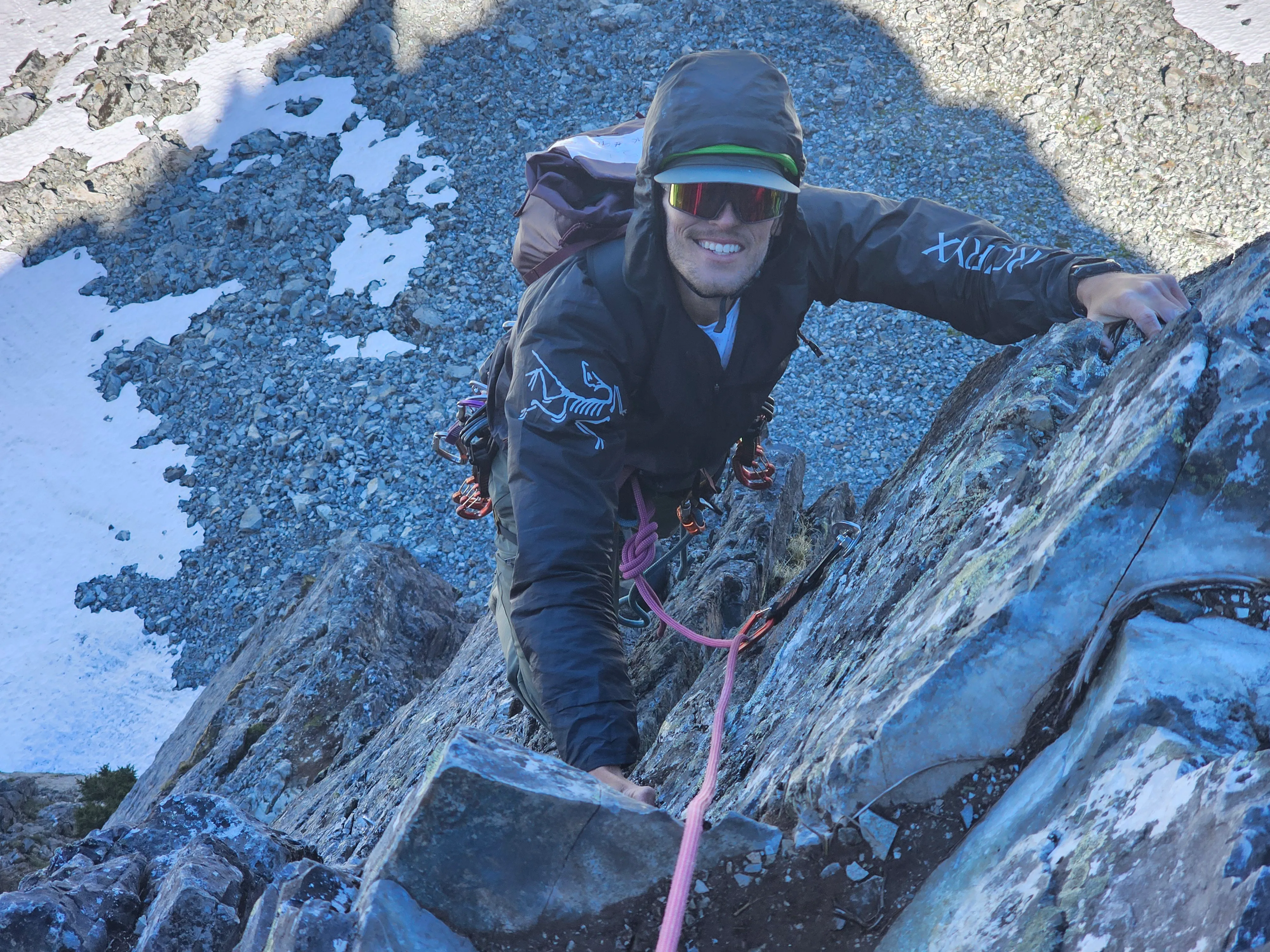
Climbing the arete. Photo by Bob
A little warning for anyone heading up: on two of my lead pitches, the 5.7 and the 5.8, there are a few holds marked with an “X.” They sit in tempting spots, but they are hella loose. Be mindful and avoid them. Pulling one could send rock onto your belayer or another party below.
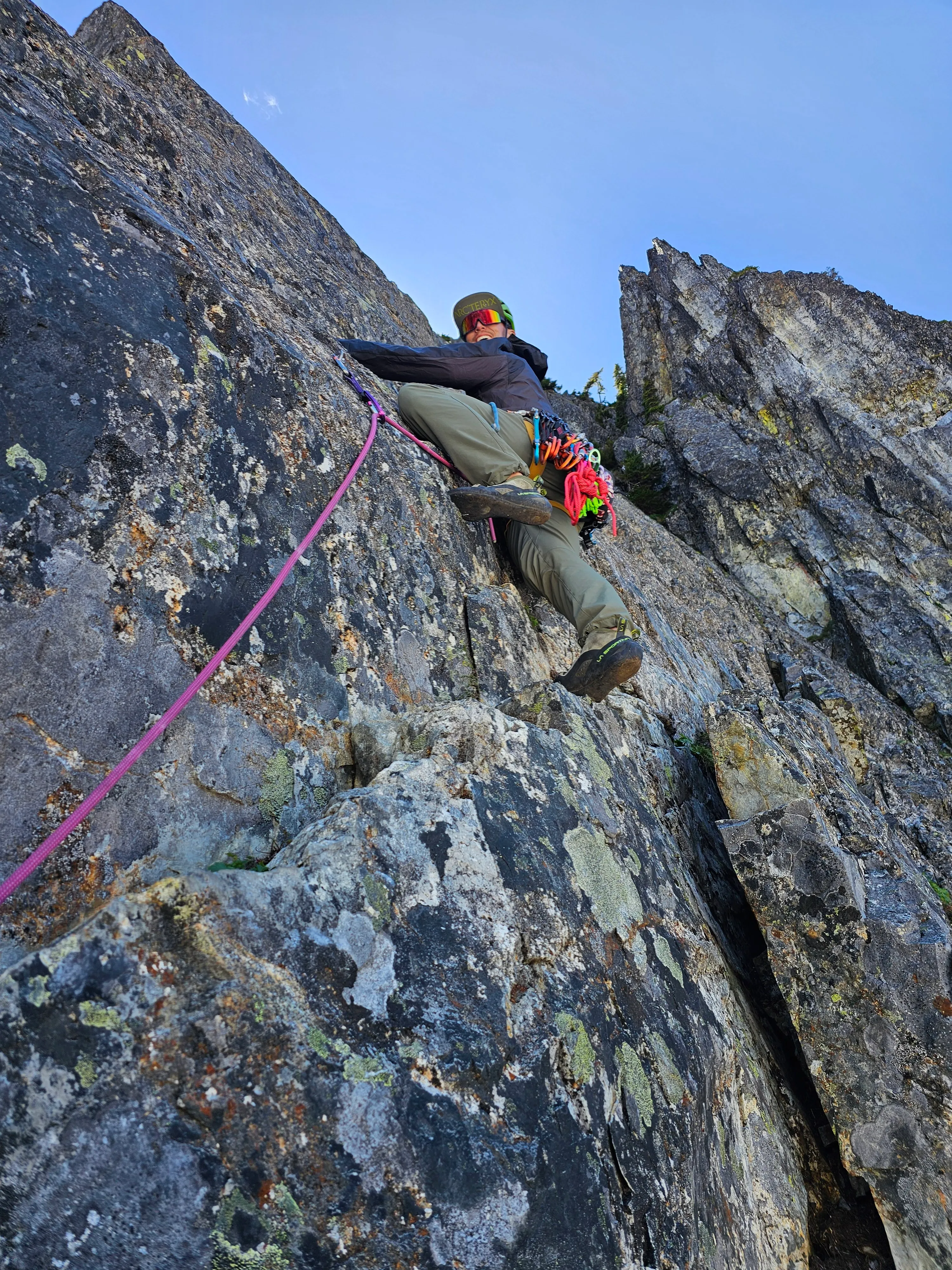
On lead on the 5.8. Photo by Bob
At the third belay station, Bob and I met Bre and Steven, a great couple passing through to climb The Fang on their way out to a wedding and some climbing in the Grand Tetons. This strong party of two had run into what might be a common miscalculation up here. The rappel down onto this pitch is fairly short, and it feels like you would sail past the belay station, but you do not. Bre was prepared either way and self-ascended back up and over to us. Shenanigans ensued, naturally, as four people shuffled around the top of a tiny boulder, rotating, untangling, and adjusting. Bob knocked out the short pitch with ease and I was soon right behind him. Bre and Steven carried on down the rappel stations with no issues. A high-stoke pair and a great couple to meet. Good luck in the Tetons if you see this.
Following that short pitch came a fun wrinkle. In all the chaos, with half a rack clipped to the anchor, Bob had gone up without his tube-style belay device, the Reverso, which happened to be his only one. So how was he going to belay me up so I could hand it back to him? Mark had the answer: the Petzl Micro Traxion. Bob belayed me on it without a hitch, and I felt completely safe the whole way. I love those Petzl traxion tools.
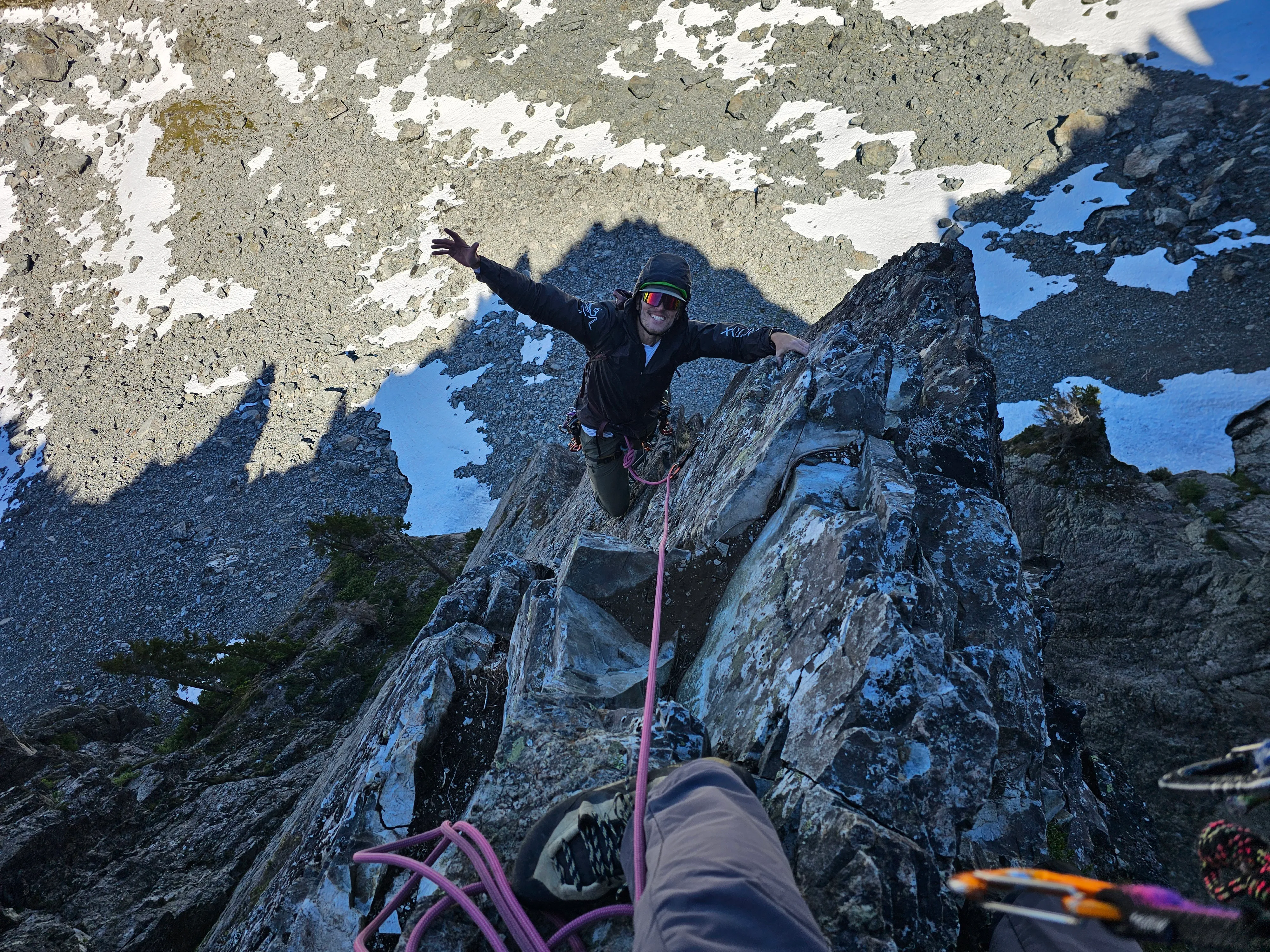
Soaking up the exposure. Photo by Bob
When we reached P5, the Tsunami pitch, I lost rock paper scissors for the lead. Bob plays a variation he calls stone in hand, and he ripped the pitch clean. The guy is a seriously good climber. I want to come back and lead Tsunami myself.
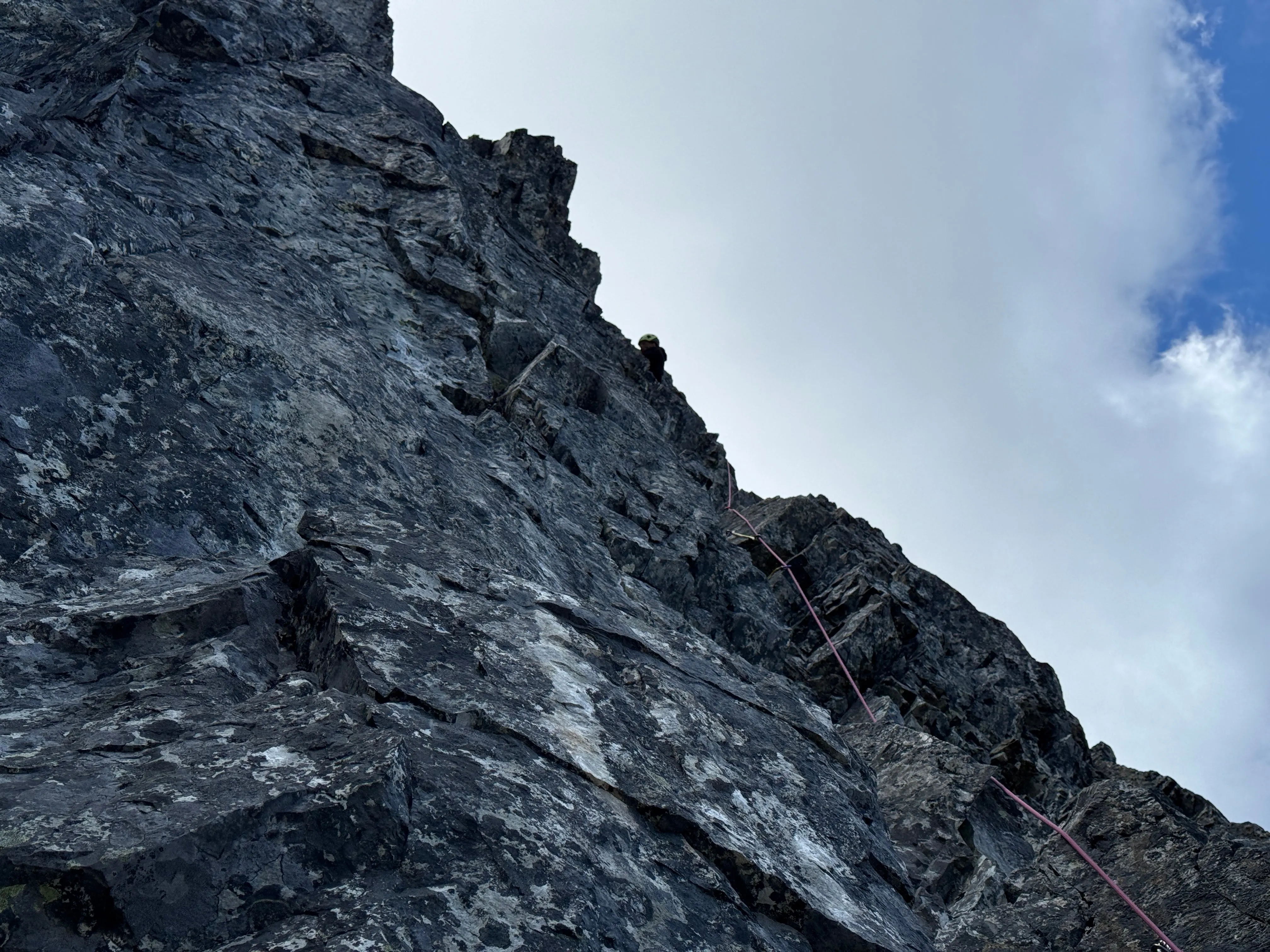
Bob on lead, making it look easy
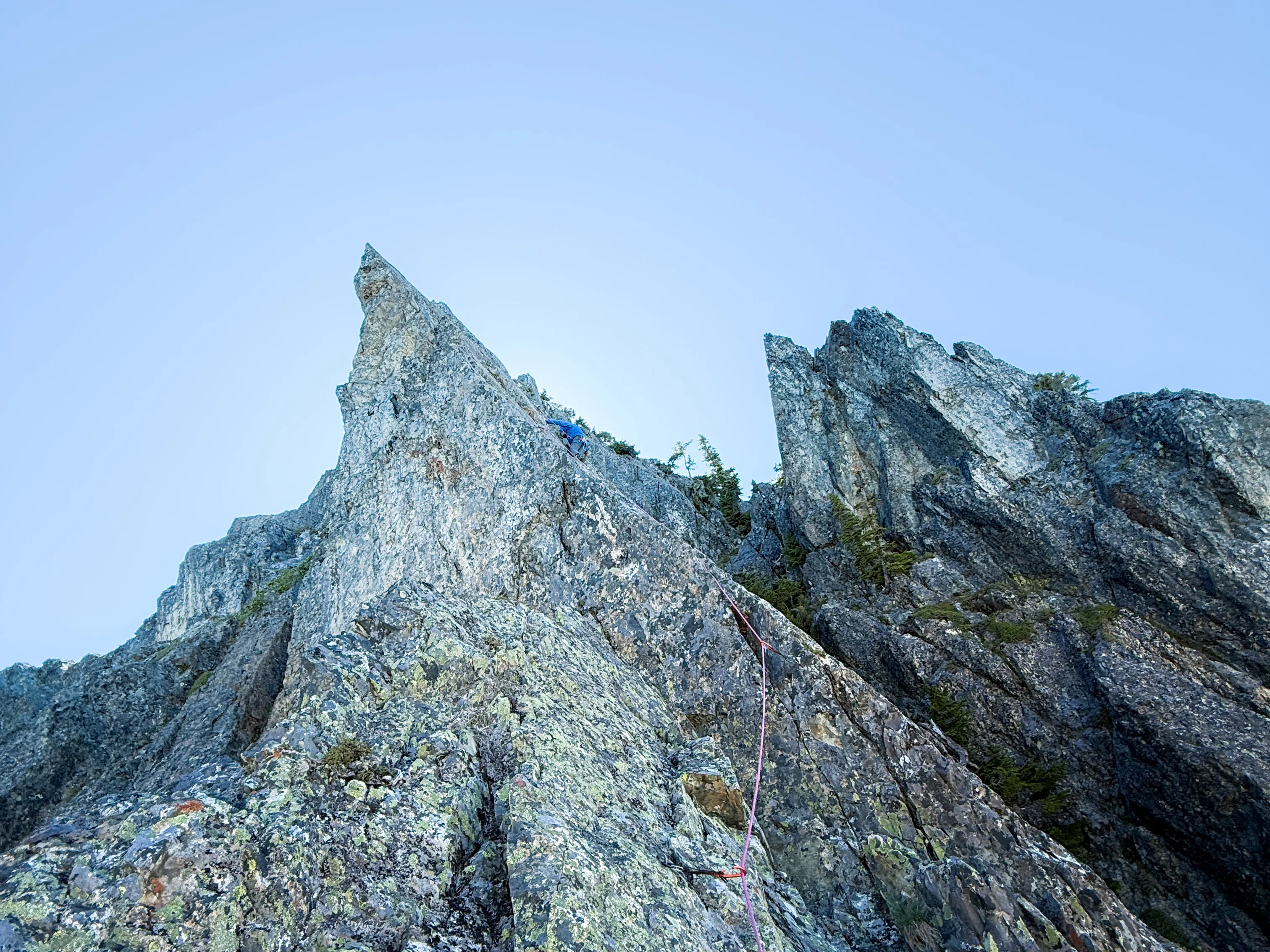
The Tsunami pitch, one of the later and more memorable ones
The Summit
The summit delivered. We could see almost every volcano in Washington from up there, with only St. Helens hiding. The Tooth was right next door too, close enough to hear the parties climbing and descending on it. Back in the sun at last, we went from chilled to hot again almost the second we topped out, peeling layers right back off.
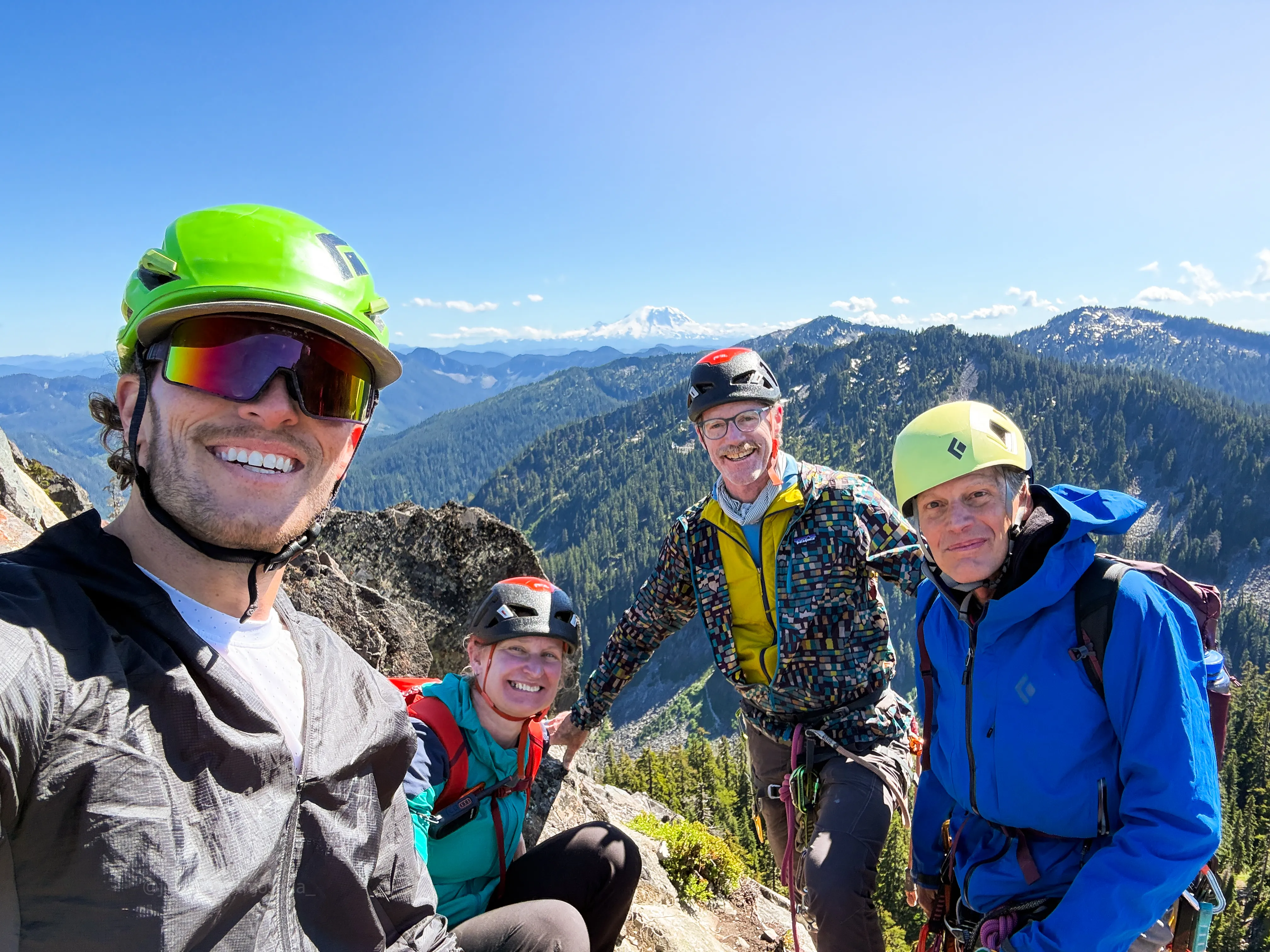
On top of The Fang, almost every Washington volcano on the horizon
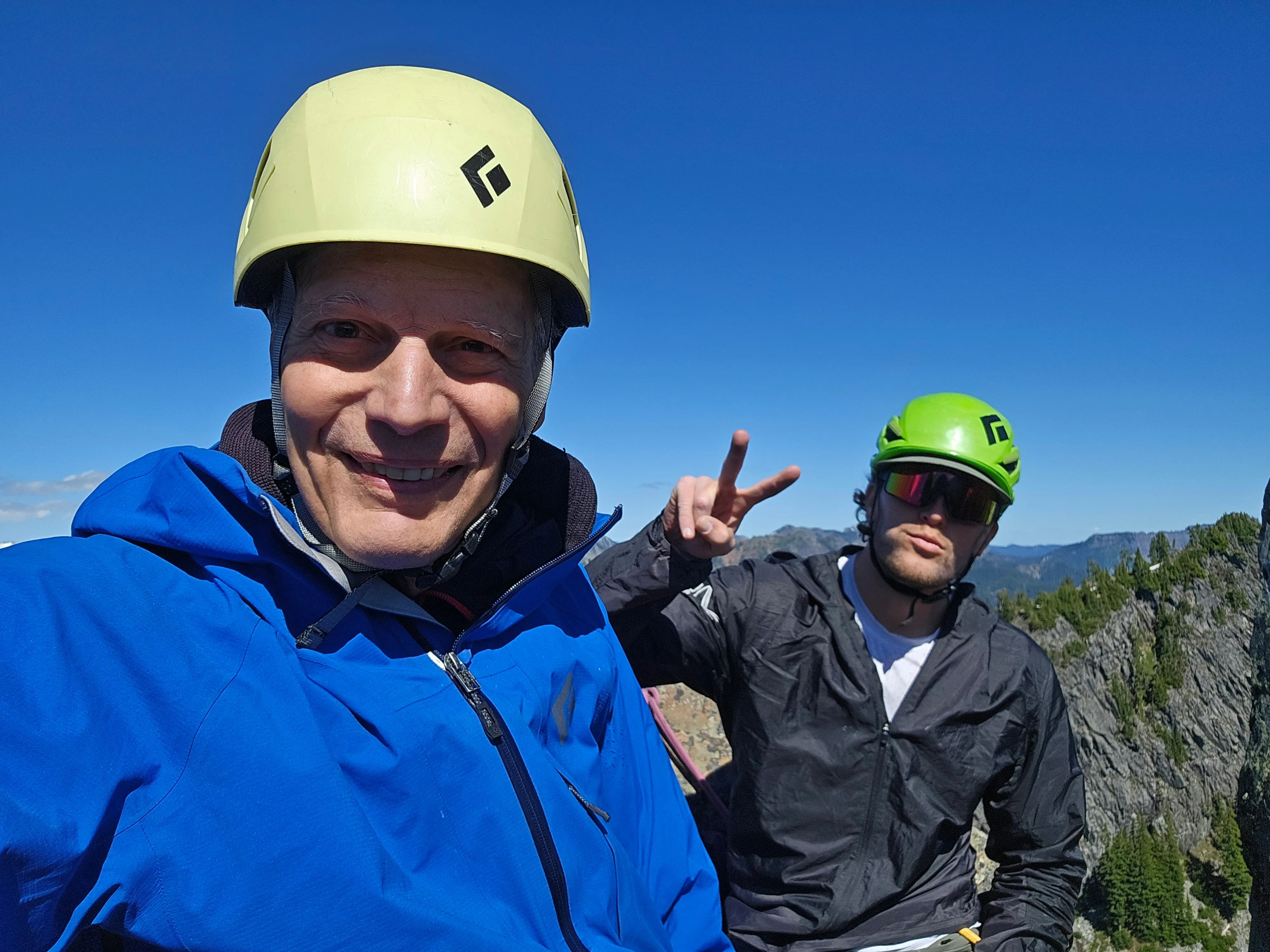
Bob and me on the summit. I am always eating. Photo by Bob
The Descent
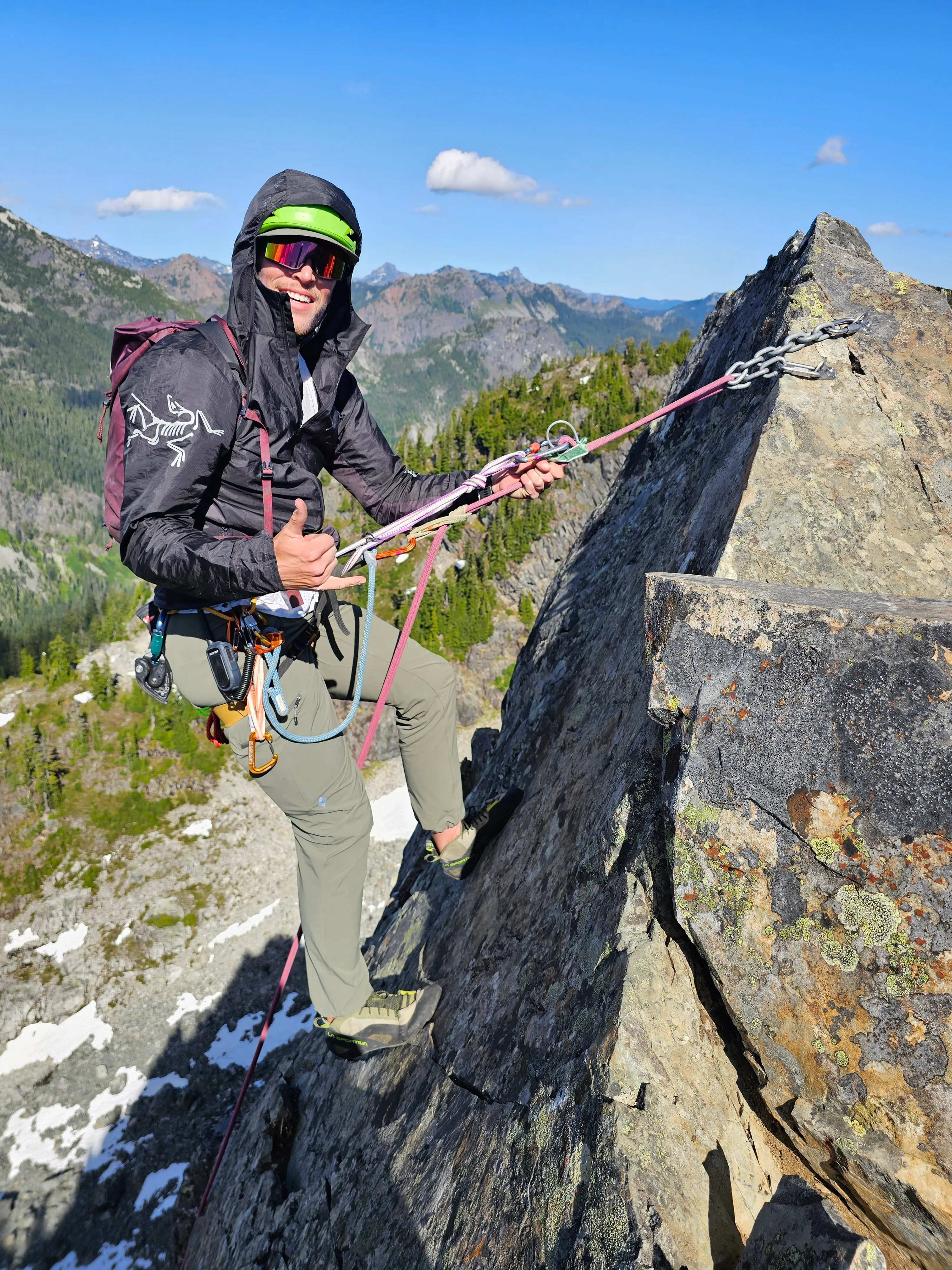
Dropping into the first steep rappel off the summit. Photo by Bob
The descent is a series of rappels, and there is one thing you have to know. From the base of P5 (Tsunami), the rappel runs all the way to your knots. Tie them carefully and keep them near the ends, because you need every bit of the rope to stretch to make it. The ledges up top were a little tight, but it all worked.
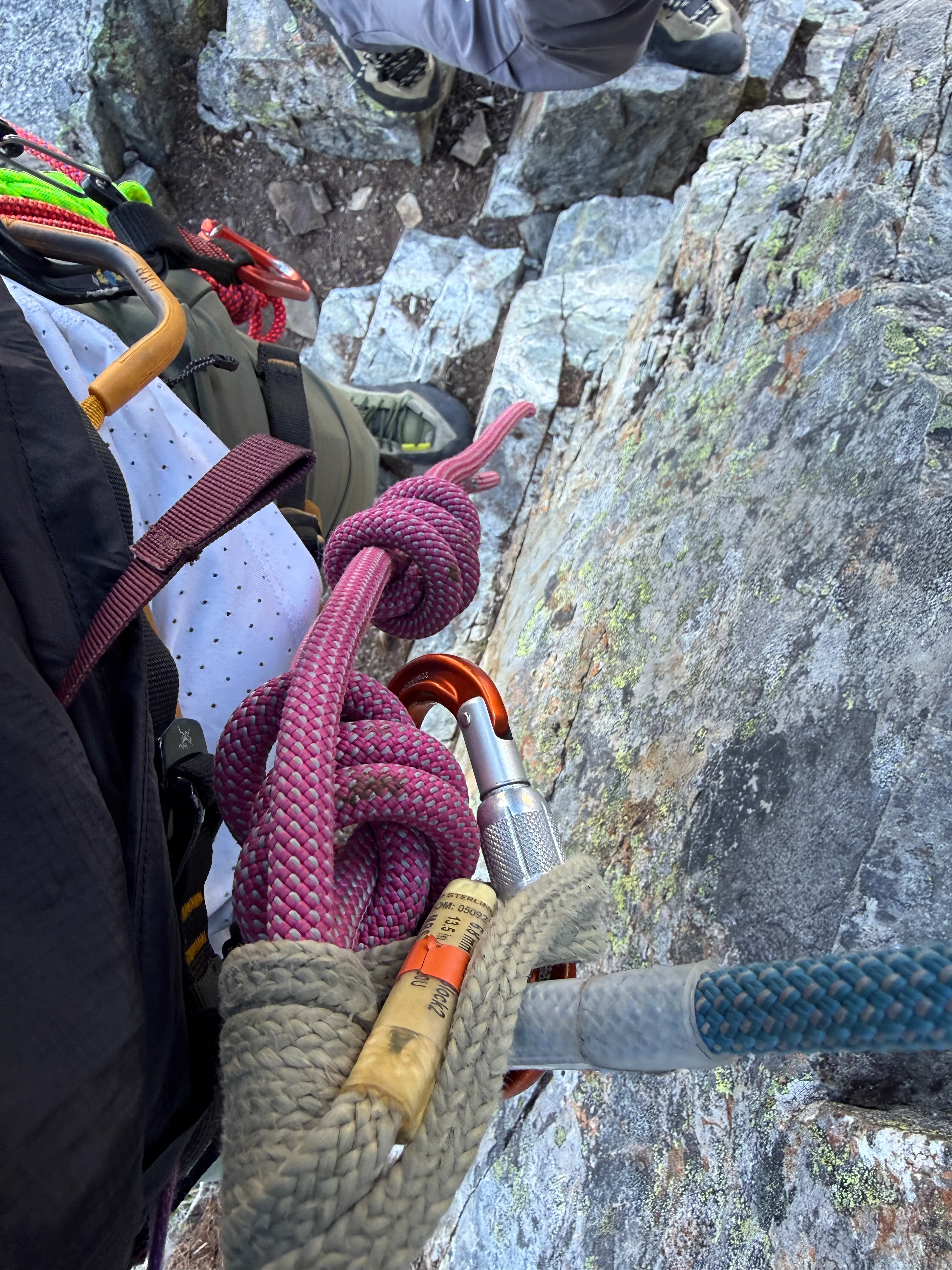
The end of that long rappel. You go all the way to the knots, third hand backing me up
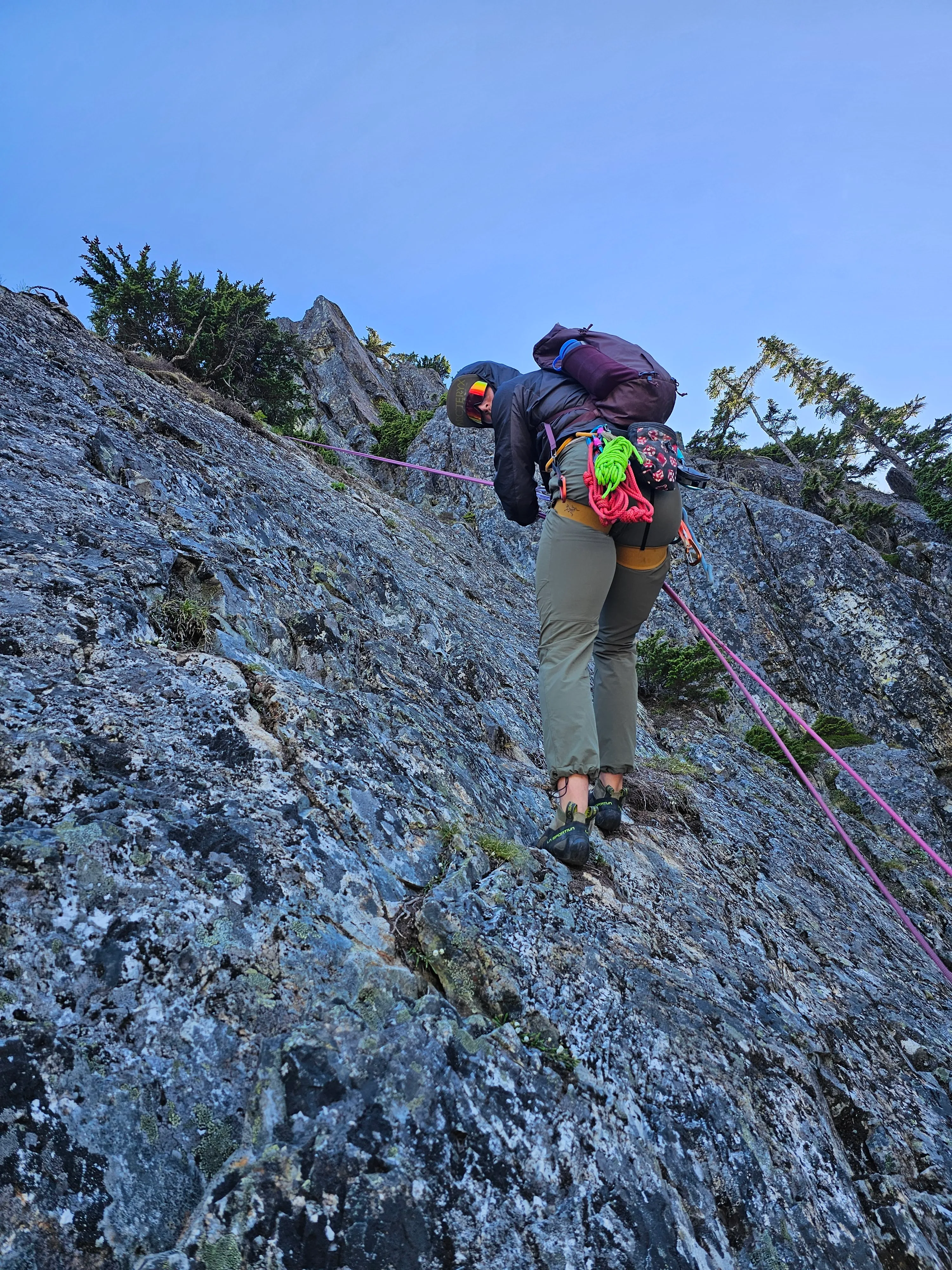
On rappel. Photo by Bob
The payoff is the second-to-last rappel. It drops straight down past some overhang, so you can rappel fast and swing out into the air as you go. One of the more fun raps I have done.
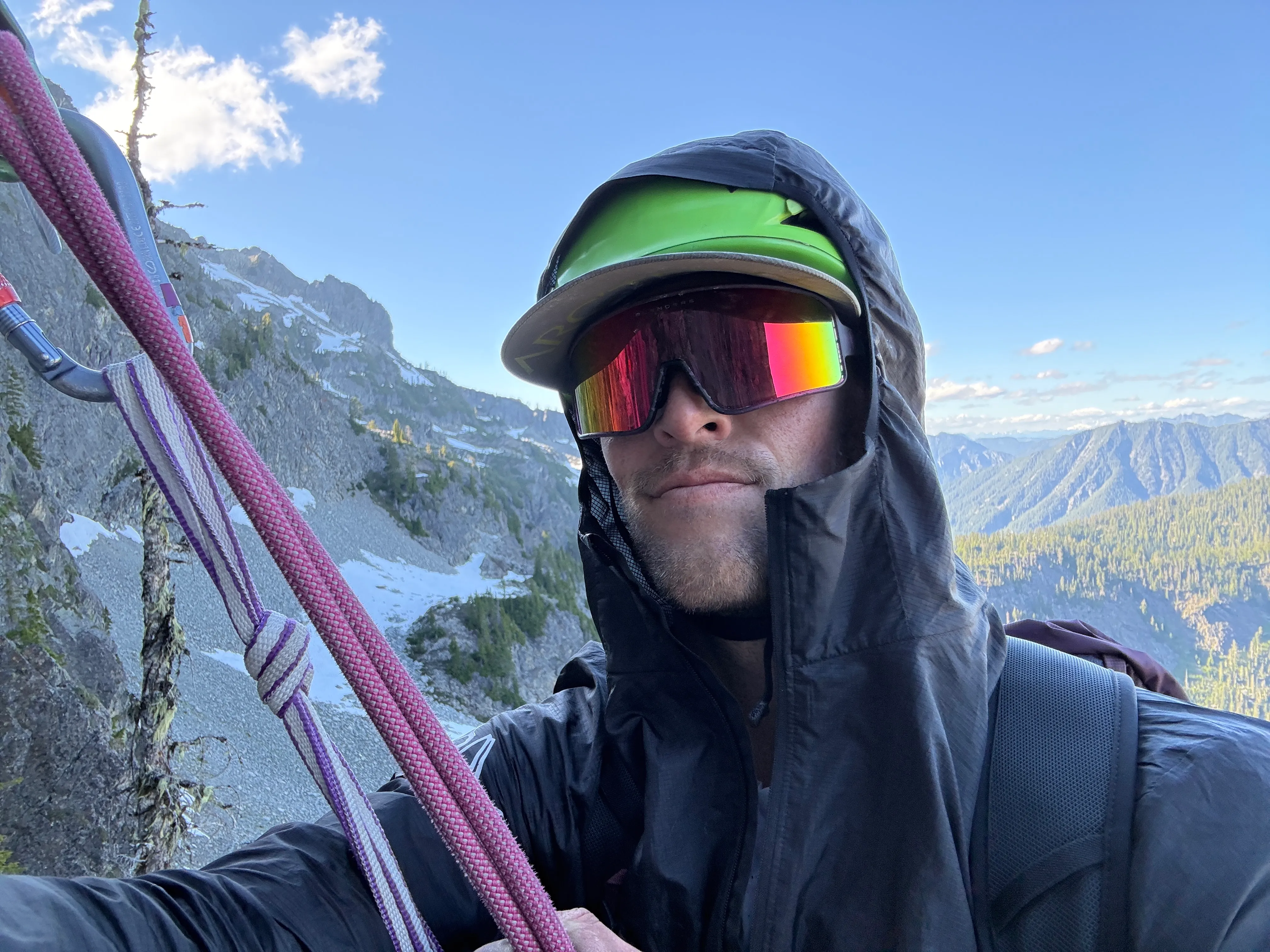
Hanging out on the rappels
Back on the shady side of the wall for the rappels, the cold came roaring right back and we layered up all over again. From baking on the summit to shivering on a hanging stance in the span of an hour. The mountains really never let up on you.
Fuel for the day: a Sweetgreen avocado cali chicken wrap saved for the summit, plus a rotating cast of sugar. Cow Tales, Nerds Gummy Clusters, chocolate covered pistachios, a Nature Valley nut and fruit bar, and a Nature’s Bakery fig bar, the supposedly healthy cousin of a Nutrigrain. Whatever keeps the legs moving on a 12-hour day.
I have a stack of trad routes in the North Cascades coming up, and I am looking to dial in and tick off more iconic lines. With the low snowpack this year and wildfires likely to start early, I am packing in as much as I can before the season disappears.
The whole group had a blast. Onward.
Route Reference
The route stats below come from the first ascensionists’ description. Full credit to the developers, Graham Zimmerman, Ian Nicholson, and Tino Villanueva. For the full topo and the detailed pitch and rappel beta, see the route page on Mountain Project.
- Grade: II, 5.10a, 7 pitches, about 650 ft. Fully bolted.
- Gear: 13 to 14 quickdraws and a 60m rope.
- Trailhead: Exit 52 off I-90 at Snoqualmie Pass, then Alpental Road to the Alpental lot (3,100 ft).
- Pitches: P1 5.6 (70 ft, 7 bolts), P2 5.10a crux (105 ft, 13 to 14 bolts), P3 5.9- (40 ft, 4 bolts), P4 5.8 (105 ft), P5 “Tsunami” 5.9 (95 ft, 12 bolts), P6 5.3 (70 ft), P7 5.7 (115 ft, 10 to 11 bolts).
- Descent: Six rappels back down the line, each within a 60m. Full sequence on Mountain Project.
Follow me @journeywithjoshua_ on Instagram for all my adventures.
The Fang Gear Loadout
Affiliate links, I may earn a commission, never at extra cost to you.
Carry & Move
-
Osprey
Atmos 65L
My do-everything pack. Carries heavy loads comfortably, ventilated back panel. Use it for most activities.
$300 -
Blue Ice
DragonFly 18L
Summit pack. Ultra-minimal for the final push — just water, layers, and snacks.
$90 -
La Sportiva
TC Pro
The classic all-day multipitch shoe. Comfortable enough to keep on through long pitches and edges like a dream. My pick for granite.
$240 -
La Sportiva
Aequilibrium Speed GTX
Light mountaineering boot, but mine are done. Still damp from Blum, and the zipper blew just walking on this trip. Officially retired. I would not buy them again.
$430 -
Alvada
Merino Wool Crew Socks (3 pairs)
Cheap merino crew socks that punch above their price. Warm, cushioned, and a fresh pair for summit day is a small luxury.
$22
Climbing & Snow
-
Black Diamond
Vapor Helmet
Ultralight, great ventilation, fits over a beanie. The green one.
$100 -
Arc'teryx
AR-395a Harness
All-around alpine harness. Light for glacier travel, enough gear loops for a trad rack when needed.
$200 -
Black Diamond
60m Climbing Rope
My single rock rope. A 60m covered every pitch and rappel on The Edge of Time.
$200 -
Petzl
Djinn Axess Quickdraw
Workhorse sport draws. Easy clip, solid keylock biners, fair price.
$20 -
Black Diamond
HotForge Hybrid Quickdraw
Affordable hybrid draws that round out the rack without breaking the bank.
$15 -
Wild Country
Session Quickdraw
Budget draws that clip clean. A few of these fill out a sport rack nicely.
$13 -
Mammut
Alpine Draw
Extendable draws for cutting rope drag and building anchors. Paired one with an Attache locker for the belay anchor.
$20 -
Mammut
Contact Sling 8.0 (180cm)
Two 180cm Contact slings for anchors and extending placements. Light, simple, always useful.
$15 -
Petzl
Attache Locking Carabiner
Pear-shaped locker — belay biner, master point, anchor. Clean nose for smooth rope handling.
$18 -
Black Diamond
RockLock Triple-Lock Carabiner
Triple-action locker for the master point and anywhere I want zero chance of it opening.
$22 -
Petzl
GriGri
Assisted braking belay device. Non-negotiable for any roped climbing.
$120 -
Petzl
Reverso
Guide mode belay + rappel device. Lighter than the GriGri — great second device for multi-pitch.
$35 -
Petzl
Micro Traxion
Progress capture pulley that doubled as an improvised belay when Bob ended up without his device. Tiny, bombproof, and I love these traxion tools.
$140 -
Sterling
Hollowblock 2
Friction hitch cord for autoblock backup on rappels and crevasse rescue prussiks.
$20 -
Sterling
Cordelette 7mm (30ft)
30 ft of 7mm cord for anchors. Beefier than my alpine cord for cragging and multipitch belays.
$25 -
Generic
Chalk Bag
An old lucky dice chalk bag I have had forever. No idea the brand, but it has tagged a lot of summits.
Layers & Apparel
-
Rabbit
Ice Perf Short Sleeve Tee
Breathable next-to-skin layer. Light and fast-drying, moves like a running shirt because it basically is one.
$48 -
Arc'teryx
Atom Hoody
My do-everything midlayer. Synthetic insulation that breathes on the move and shrugs off a little wind. Lives on me most of the climb.
$300 -
Arc'teryx
Norvan Windshell Hoody
Featherweight wind shell that stuffs to nothing. Cuts the wind on exposed ridges without the bulk of a hardshell.
$190 -
Black Diamond
Alpine Pants
Durable, stretchy pants that move well on rock and shrug off granite scuffs.
$150 -
Arc'teryx
Aerios 5-Panel Cap
Breathable cap that keeps the sun off on long snow days and dries fast.
$40 -
Mount to Coast
Running Sleeves
Arm sleeves for quick temperature regulation. On for the cold start, pushed down or stowed once the sun comes up.
-
Badger
SPF 50 Sunscreen
Mineral zinc sunscreen — thick, stays put on sweaty glacier days. Reef safe too.
$16 -
Blenders
Eclipse Sunglasses
Daily driver sunglasses for approaches, trail days, and driving. Cheap enough to not stress about.
$50
Electronics
-
Garmin
Fenix 7 Pro
My watch for every climb in 2026. Maps, tracks, and a battery that outlasts the longest days.
$700 -
Rocky Talkie
Mountain Radio
Carried a pair for team comms on the mountain. Glove-friendly, leashed so they do not drop, and they just work when the team is spread across a slope.
$110 -
Garmin
inReach Mini 2
Satellite messaging and an SOS button for where there is no signal, which is most of the time up high. Non-negotiable safety kit.
$400